Showing posts with label newborn. Show all posts

Wednesday, May 26, 2010

The Girl from Da Burg at War


W ith things heating up to fever pitch in the Middle East, and as a result of this morning's emergency drill, I was brought back to the time of the first Gulf War, when I lived on an isolated mountaintop settlement in the Judean desert with my husband and (then) seven children. I decided to jot down some memories of that time in installments. It's too long to write at one sitting.

In the days leading up the first Gulf War, my husband and I went into our usual at-odds Gemini/Virgo stances with firm entrenchment. Dov pooh-poohed all the talk about sealed rooms and bombs and said there weren't going to be any bomb attacks and even if there were, they wouldn't reach our little mountaintop in the Judean Desert. On the other hand, I was feeling an urgent need to prepare and follow the instructions issued from the Home Front Command. I am the girl who always read all the instructions before taking tests in school or cooking pasta. I like following instructions and being prepared. It comforts me.

I wanted to get the recommended plastic sheeting to cover the window in the room we had set aside to become our "sealed room" in the event of an attack. Dov refused. He just kept saying it was a lot of horse-pucky and that even if there WERE an attack, plastic sheeting on the windows wasn't going to be of any help.

At least I didn't have to worry about getting gas masks, since the Home Front Command sent people out to us to issue them and train us in their use.

Another concern I had related to the flimsiness of our home. We lived in what Israelis call a caravan: a trailer set on cinder blocks. This is the typical accommodations of the Israeli settler until such time as permanent housing is built. Caravans are made out of plastic with an asbestos exterior. I had no confidence that we would be safe inside this space no matter whether the attack would be conventional, biological, or gas.

The Home Front Command wanted us to choose an inner room to serve as our sealed room; one with no windows was preferred. No such animal exists inside a caravan. I decided to designate our bedroom as the sealed room.

Dov wouldn't cooperate with my preparations. He just kept rolling his eyes as I transferred dry goods to glass jars with lids, filled bottles and jerry cans with water, and moved them into our crowded little bedroom along with all the masks, tents, bedding, toys, and books for our 7 children.
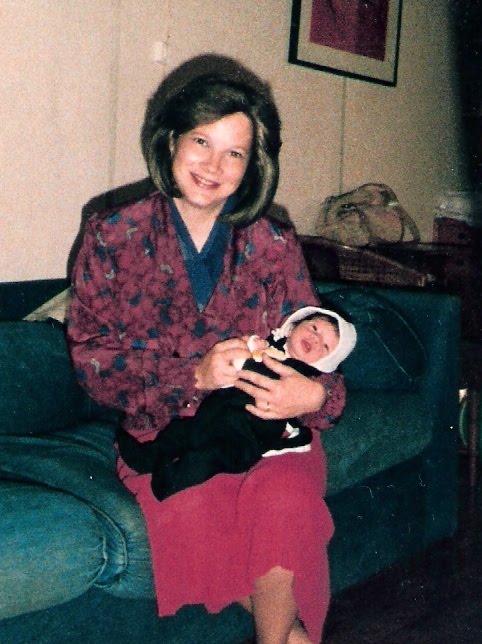
My youngest was a newborn nursing infant. He was three months old when the war did at last break out. Though we'd been shown a film about caring for infants in their gas-proof tents the movie didn't do much to assuage my feeling that I was a major character in a sci-fi movie. The tents had a built-in sleeve with a glove so that I could reach in and calm the baby, but not pick him up or make skin-to-skin contact. I expressed and froze milk after each time I nursed him so that I would have a store of frozen milk at the ready.

Then Dov got his "tzav." He got notification that his basic training in the IDF was to begin. "Oh, great," I thought, "Dov goes into basic training on the eve of the war, right after I've had a baby, and I don't even have a frigging plastic sheet for the window."

Dov and I had, at that point, never even spent a night apart from each other in all our married life. But it looked like I was going to be on my own should war break out. Well, not quite alone: I'd have SIX LITTLE KIDS AND A BABY to care for. *sigh*

Everything at this point in time took on an eerie tinge of unreality and frightened expectation. Just before he left for the army, even Dov began to think that he should prepare me as well as possible. I have a memory of him taking me around the house and showing me a few things to do with the Uzi, such as how to shoot around corners and bedroom doors. He also practiced with me a maneuver in which, should I hear the enemy break into the house, I'd flip the bedroom mattress up against the wall and get down low behind it with the kids.

Hmmmm. This was beginning to resemble an action movie, only it was the real deal: the girl from Pittsburgh at war.

To be continued...


Friday, April 30, 2010

Failure to Bond


A Mother in Israel had a recent blog entry asking what we thought about the following news item:

Visit msnbc.com for breaking news, world news, and news about the economy


The author of this blog felt that the language of the piece was a little strong, characterizing the mother's behavior as "pathological" when the same would not have been said about a runaway husband. What did we, the readers think, she wanted to know.

The truth is, we know very little about why this mom left her husband and child and I don't want to damn her without having the facts at hand. The mother doesn't want to issue a statement or explain her actions. The father says he doesn't blame her. The viewer has very little information on which to base an opinion.

We are left to read between the lines or try to translate the facial cues of the major actors in this piece. The father, well, to be kind, he seems kind of dim-witted and vacant. He seems drugged or perhaps has a mental handicap of some kind. The mother has an odd smile lurking at the corners of her mouth. Is this psychosis or just a knee-jerk response: a nervous smile that has nothing to do with mirth?

So, not having any firm information, I had to admit that unlike the other women who added comments to that blog, I agreed with the experts who felt that there was something quite wrong with the mental status of this mother. It's not that I feel that a mother can be held to a different standard of behavior than a man. I am adamant that any parent who walks out on a spouse and child without warning is wrong and sick. But there is something deeper going on when the parent is the biological mother of the child who is abandoned.

All parents have an age preference regarding children. Some parents only begin to derive pleasure from their children once they smile, others enjoy their children most once they learn the knack of speech. I like newborns best; whereas my husband finds newborns kind of, well, creepy. Dov does an awesome imitation of a newborn pummeling and scratching at his own face because he lacks basic neurological control of his own limbs.

Dov is a wonderful father, connected and involved, but is just a touch squeamish when it comes to newborns. I decided that maybe some of this had to do with the natural disadvantage that a father has in bonding with a newborn infant.

After a baby is born, it is usual for the infant to be placed on the mother's stomach. There may be some skin-to-skin contact between mother and child. At any rate, there is no doubt that what happens between a mother and a baby just after birth is a kind of magic. Studies have been done that prove a baby will, on its own, inch up from the mother's stomach to her heart and breasts where there exists the sources of love and nutrition.

During this time the mother experiences a great rush of feeling as she connects with the baby she has harbored over the past nine months deep inside her body.A connection is forged between mother and child which lasts a lifetime.

A father is forced to look on at a bit of a remove from these mystic goings on. He doesn't get to partake of an experience in which he is the first and foremost human to enter the life of the child. He is excluded from the mother/child cocoon in which no one else may ever enter. The significance of the father comes into play at a much later date.

When I was pregnant with my fourth child, I decided that when it came time for the midwife to hand me my son, I would direct her instead to hand him to Dov. I wanted him to have that taste of enchantment, that singular experience of delicious insularity that can exist between two beings, and so it was.

Yehoshua was born just after we ushered in the Sabbath eve. I motioned to the midwife that she should place the baby in my husband's arms. I watched them gaze deep into each others' eyes and lo and behold, this infant, just a few seconds old, smiled at my husband. Smiled!

Dov looked at me open-mouthed--had he really seen the baby smile?? I nodded: I'd seen that smile, too. It was real. Dov said that Shua was filled with the joy of the Sabbath and that this was the reason for this beautiful gift, that first smile, in the first moments of our child's life.

I was so happy to give my husband this gift of being the first, of getting that bit of bonding in FIRST.

I can't swear that being the first to hold Shua meant that the two of them have an eternal bond that is unbreakable. I don't know whether Shua's bond to Dov is greater than my own. I don't want to make any false claims.

But I do know that my bond to my children is unbreakable and I would include Shua in this, since after all, I nursed him for two years. I could never walk away never to return--not from Shua and not from any of my children.

I can only conclude that the mother in this news item failed to bond to her child. There must have been some kind of psychological stumbling block, perhaps postpartum depression, perhaps something else, that got in the way of the magic.

Monday, November 9, 2009

Brainstorming

"If I get like that, shoot me," said Dov, talking about my latest elder care charge, "V" Okay, you're all thinking, "Hey, wait! I thought Varda was a writer."

Well, yes and no. I'm a writer, but my career fortunes rise and fall and sometimes, I swallow down my pride and take work that has nothing to do with writing, and everything to do with paying the bills. I've cleaned houses, watched babies, baked cakes, and watched the elderly. If I had my druthers, I'd never leave my keyboard, but it's an imperfect world.

The truth is there are two ages I really like: newborns, and the really old. Newborns don't care much about impressing their handlers, ditto, the elderly. There's something really attractive about that kind of honesty. Newborns are awe-inspiring for their potential, and the elderly inspire awe for the breadth and depth of their experience and knowledge.

At any rate, I have a genuine fondness for old people, and lucky for me, they seem to like me back. I now have a reputation as an A1 elder care person and I'm always being offered new positions. When my writing work is bringing in the big bucks (yeah, right), I can turn down these opportunities, but right now, I cannot.

So it was that I got a call one day from a guy looking for someone who could watch his mother who has been diagnosed with dementia. As he fleshed out the details, I had a feeling I knew the identity of the lady in question. I asked for her name, and sure enough, it was V. I told V's son, "This is a real coincidence, because I was V's neighbor for a few years and we were close friends. I'm sorry to hear about your mother, but I can't think of a better situation than to have me, her dear friend, take charge of her care."

So it was that I began the heartbreaking job of witnessing V's decline. V is a highly intelligent woman, attractive and looking much younger than her years. But V is a bit of a character, always was. So is her husband, L. Maybe that's why it took so long to diagnose V's dementia.

At any rate, somehow, I am able to understand what V is trying to express, even when she is casting about for phrases and substituting words that mean nothing like what she is trying to say. There is an unbelievable rapport between us and I have to admit that I get an inordinate amount of pleasure from being able to grant her the gift of understanding. The truth is, I don't find it much harder understanding V's speech than understanding the pre-speech of my children back in the days when they couldn't speak but ached to be understood. I was always there to provide them with that commodity.

There are other similarities between being with my new charge and spending time with infants. When my babies were small, I'd be so immersed in their worlds that I found myself mimicking their speech patterns. The same is true of spending time with V. I come home from work and find myself using word substitutions and speaking out of context. It's kind of frightening, actually. I have pointed it out to my husband and he agrees: I'm in a state of dementia for at least 10 minutes after I leave V.

Maybe this is related to the fact that I was big into drama classes as a teen and acted in any production that came my way. I still have my book on the Stanislavski Method. I can feel myself straining so hard during the five hours I care for V, trying to understand her every verbal nuance. I guess, at a certain point, I merge and become one with V. The scary part is worrying I'll get stuck and won't be able to make it back.