Showing posts with label Kars for Kids. Show all posts

Tuesday, January 28, 2014

The Day the Soup Ran Out

Today is the day the chicken soup ran out. And still, my chest continues to grind out ugly pneumatic music, alternating between a rhythmic rattle to remind me at every turn that something is wrong, dreadfully wrong; and a wheeze that makes me look around to see who else is there in the room with me (answer: no one).

Though I long to stay in bed, I force myself up and out of my soft, warm, flannel cocoon. It is a kind of a test: am I well enough to work today—to cook and do housework?

This is the way I have lived my life in the sick zone since becoming a mom. If my hands and legs respond to basic commands, I’m well enough to be up. If not, not. You just can’t tell from a prone position.

So today, on the day that the soup ran out, I test my limits, moving with slow caution to see what I can do, what I will do, because will has everything to do with it.  The phrase, “weak as a kitten,” comes to mind without much thought about what this actually means. Is a kitten weak? Do I care?

The soup has run out and I need soup, as any mom knows, and I’m a mom and surely know this. I need soup to get well—to get back the strength that will get me back into the workforce, where I need to be. Back at my desk at Kars for Kids and also at my other full time position: Resident Mom.

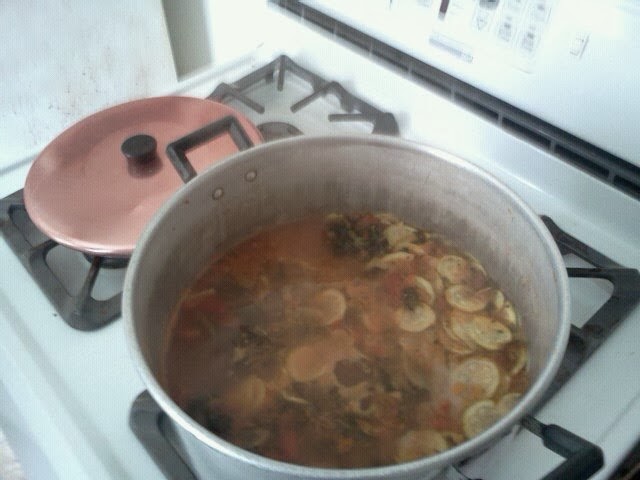
So working by rote, I gather the ingredients I need to get well: a can of chopped tomatoes and one of kidney beans, an onion, 6 cloves of garlic, and a red bell pepper. Squash and carrots and potatoes, too. I know what I need because I’ve made this soup so many times I can put it together in under an hour with no thought whatsoever.
(photo credit: Moshe Epstein)

(photo credit: Moshe Epstein)

(photo credit: Moshe Epstein)

(photo credit: Moshe Epstein)

It’s not art in the bowl. Not like my chicken soup which is practically speaking an all-day process. But it’s good, it’s healthy, and it warms me from the inside out.

I ladle out a bowlful and breathe in the steam. “This will make me well,” I think. And there is satisfaction in knowing that the power was in my own two hands, all along.

Minestone

Ingredients:

•    1 red pepper
•    1 onion
•    6 cloves garlic
•    3 Tablespoons olive oil
•    3 carrots
•    3 potatoes
•    3 vegetable marrows or zucchini (kishuim in Hebrew)
•    Frozen chopped spinach
•    1 can chopped tomatoes (agvaniot kubiot in Hebrew)
•    ½ teaspoon crushed red pepper
•    3 liters vegtetable stock or parve chicken soup (marak adif in Hebrew)
•    ½ cup broken spaghetti or other pasta
•    1 teaspoon oregano
•    ½ teaspoon basil
•    ¼ teaspoon thyme
•    1 can kidney beans, rinsed, drained
•    Grated cheese for serving


Method:


1.    Chop in food processor or by hand, the garlic, onion, and red pepper. Sauté on medium heat in olive oil until onion is translucent.

2.    Chop carrots and thinly slice potatoes and vegetable marrow either in food processor or by hand. Add to pot along with 3 liters of vegetable stock or 3-4 heaping soupspoons of soup powder and 3 liters boiling water), a handful of frozen chopped spinach balls (I like the type that is frozen in clumps), the canned tomatoes, and the crushed red pepper.

3.    Bring to a boil, then turn heat down and cook, covered, for 30 minutes to 45 minutes or until potato slices are almost tender.

4.    Add pasta and herbs. Turn heat up and cook until pasta is al dente. Add beans.

5.    Serve with grated cheese.


Wednesday, January 8, 2014

On the Side of Love

I don’t so much choose what to write about as my subjects choose me. A lot of the time that means I end up writing about really grim stuff. Not today.

Today, a lovely feel-good story grabbed me by the arms and wouldn’t let go. It was a trailer for a movie called The Drop Box and the minute I watched it, I knew I had to write about it.

The Drop Box is the story of the Give Out Love Orphanage in Nangok; a rough, blue-collar neighborhood in Seoul, South Korea. Baby abandonment is common here and hundreds of unwanted infants are abandoned to their deaths each year. Pastor Lee Jong-rak thought to save at least some of them and to that end he set up a drop box where people might leave their unwanted babies.

"The Drop Box" - Documentary PROMO from Arbella Studios on Vimeo.
The pastor wasn’t sure anyone would follow through, but a slow steady stream of babies began to arrive, some with their umbilical cords still attached. The babies came with cerebral palsy, Down syndrome, and a host of other physical and mental deformities. Thirty-two babies have been dropped off since the drop box was set up in 2009, though “just” 21 are in residence today. Each baby gets an enormous amount of love from the Pastor, his wife, and the devoted volunteers who offer their time at the orphanage.

But not everyone is happy.

The child welfare people got wind of the orphanage after seeing a television special. They say there are too many people living in this four-bedroom residence. They say that conditions are sanitary. They say the anonymity of the drop box encourages child abandonment and robs the children of knowing their biological parents.


In an interview with the LA Times, an orphanage volunteer, Peter A. Dietrich said, “Rather than look at what he can bring, they focus on what he doesn’t have. The enormity of [Pastor Lee Jong-rak‘s] mission hits you between the eyes. I don’t know anyone who goes there for the first time and doesn’t tear up.”


I concur. There’s so much wrong with the world and here is one man, at least, who is trying to right some of those wrongs. It’s a little like bailing out a boat with a teaspoon. But it’s something.

It’s that same something that had me claw my way into a job at a nonprofit that provides mentoring services for children. I’ve earned my living by writing for the past decade, but until I took the job at Kars for Kids, I didn’t feel my writing made a difference. Now I do.


I love reading the success stories of the children we help. The letters come on a daily basis through interoffice mail, from grateful parents and from the children themselves. We give these children a way to steady themselves as they make their way through childhood and on into adulthood. We get them through with a lot of love.

And love is an international language, understood by all, whether in an orphanage in Seoul, or at a summer camp in Upstate New York. I’m proud to be on the same side as Lee Jong-rak: on the side of love, bailing out the world, one teaspoon at a time.

Tuesday, December 17, 2013

Stir Crazy


The snow to end all snows is still on the ground here in beautiful Efrat and I am feeling a little bit nutso. I would say I’m stir crazy but the truth is, it’s not about being stuck in the house—it’s about not being ALONE in the house. There are people all around me, all the time.


AIEEEEEEEEEEEEE.


I vant to be alone
It started Thursday. It began snowing and it didn’t stop. It snowed and snowed and snowed some more. We ended up with over 3 feet of snow on the ground and we were all home because when it snows in Israel, everything shuts down.


It’s not that we’re wusses here in Israel. I grew up in Pittsburgh and my husband grew up in Chicago. We know snow.


But Israel is a young country and snow is an unusual occurrence so we’re just not prepared for the white stuff when it does come down. Israelis don’t have snow shovels or ice picks to clear icy sidewalks. You can’t buy rock salt here at your local hardware store. The city doesn’t have many if any snow plows or firm snow contingency plans.


Panic Buying

When the weatherman predicts snow in Israel the supermarkets overflow with people and the shelves empty out as panic buying ensues. So you’ve got to do it too, or you’ll be without basic staples like bread and milk. Stuff runs out.


The streets are narrower in Israel, so they become especially hazardous in difficult weather conditions. The low-lying areas flood. People don’t have snow tires or chains. We get especially heavy winds in Israel that down trees and electric lines. At the same time, people flock to Jerusalem from the warmer areas of the country to see the unusual weather phenomenon so you end up with icy, jammed up roads.


Furthermore, houses in Israel aren’t well-insulated and most people don’t have central heating. The cold seeps into your bones.


In short, it’s best to stay home and cuddle with the kids if you have them until everything is back to what passes as normal. Which at this time of year should be rain and not snow and freezing temperatures.


"The Look"

Now I like my alone time. I like my family, too, but not all around me all the time, especially not when I’m trying to write as per my job at Kars for Kids. And of course, my desk is in the living room and I don’t have a way to cloister myself from noise and distractions. The most I can do as my family members naturally forget to be quiet around me is to give them “The Look.”


It helps. Until the next time. Usually five minutes later.


*sigh*


So when I realized my writing just wasn’t going to happen today, I packed it in and looked for distractions on the ‘net. Since I was cooped up in close quarters with too many people for too long a time, the distractions I found had to suit my morbid mood. And oh lucky you, I’m good at sharing (don’t thank me, I’m a giver, as my friend Dave Bender always says).


A Movie About You

This website lets you customize a movie to be about you by inputting the address of your home from back when you were a kid growing up. At least that’s what it’s supposed to do. You actually don’t see much of your childhood home—it’s more expectation than wish fulfillment. But when you’re feeling nostalgic due to the weather, it’s nice when you start to type in your old address and the search engine spits it out for you. You feel acknowledged.


Here is the movie it made for me. Note that Google Street View is not comprehensive for Israeli streets, so I couldn’t make a movie for my kid with our (current) address.


Next, I found this social experiment pictorial. Here’s a quote from the page:

“After Candy lost someone she loved, she went through a long period of grief and depression. With time she felt gratitude for the time they had together and eventually she found clarity in her life by contemplating death so much. But she struggled to maintain this perspective. It’s easy to get caught up in the day-to-day and forget what really matters to you. She wanted a daily reminder and she wanted to know what was important to the people around her. So she painted the side of an abandoned house in her neighborhood in New Orleans with chalkboard paint and stenciled it with a grid of the sentence “Before I die I want to _______.” Anyone walking by could pick up a piece of chalk, reflect on their lives, and share their personal aspirations in public space.

It was all an experiment and she didn’t know what to expect. By the next day, the wall was completely filled out and it kept growing: Before I die I want to… sing for millions, hold her one more time, straddle the International Date Line, see my daughter graduate, eat more everything, abandon all insecurities, plant a tree, follow my childhood dream, be completely myself…  People’s responses made her laugh out loud and tear up. They consoled her during hard times. She understood her neighbors in new and enlightening ways, and the wall reminded her that she’s not alone as she tries to make sense of her life.”

Morbid enough fer ya?

A Fun Guy

Moving right along, here’s a fun guy. He pours molten aluminum into ant hills. But hey, Kiddies, these are fire ants that are pests, so it’s okay to torture them with the equivalent of a manmade mini-Pompeii. Besides, it’s ART.

It actually is really cool art. You have to watch the whole thing to see why (alternatively, if you don’t like to watch fire ants tortured you can just skip to the end of the clip).


Next up, I contemplated some really neat architecture, which is a depressing thing to do when you’re living in a moldy rental, so yeah. Really fit my moody blues.

Last but not least, I found this totally useless item. Actually, it may be useful for you, if you’re the type to fall asleep on buses, trains, or planes. Unfortunately, I am too hypervigilant—I’d be afraid I’d miss my stop—to ever appreciate the merits of this estimable sleep travel hat that both cushions your head from bumps and shields your eyes from the light. It’s called—you guessed it—the ostrich pillow.

Come to think of it, maybe I could use that ostrich pillow hat to feel more, um, alone. That is, if they’re all still home tomorrow. Until then,

AIEEEEEEEEEEEEEEEEEEEEEEEEEEEEEEEEEEEEEEEEEEEE!

Thursday, December 12, 2013

A Rare Judean Snow Day

Yesterday it was gusty and cold and the rain came down in torrents. It was the kind of rain that would soak through your clothes clear to the bone in the dash from door to car. I didn’t want to go anywhere. I wanted to crawl beneath a quilt and think warm thoughts. But it was Wednesday, and Wednesday night means choir.

There was a chance of snow, so I called to see if our choir director was going to brave the roads. But I already knew what she’d say. Judy’s too tough to let a bit of wind or rain push her around. Besides, she said, they always say it’s going to snow and it never does.

I got home from choir at 10:15 PM and the first reports of snow came in half an hour later on our local Efrat e-list. Dov sniffed. “It’s not going to really snow until Thursday night.”

No School

But I woke up this morning and there was my youngest on the sofa. “No school?” I asked.

I looked out the window. Oh my. It was a world of white.

I love the way that happens. That surprise of seeing thick snow first thing in the morning, when the night before, there’d been none.

Usually, I’m the first one out there making snowballs and angels. A good snow is so rare in Efrat and I don’t like to waste it. I love to play in the snow. But today, I just wanted to stay in and be warm.

Work, Work, Work

Besides I had to work waiting for me. *sigh* Thursdays are all about that rush to fill my weekly quota of articles over at Kars for Kids. Still, a snow day is a snow day and that’s not to be taken lightly.

My firm belief: a snow day can be celebrated, even with work beckoning and even from inside the home, all snug and warm. I put up a pot of soup and brainstormed appropriate snow music, but the truth is, it was a no-brainer. I give you The Snow is Dancing, by Claude Debussy.


Son number six stumbled out of his room on hearing the music, cocked his head to listen, and then looked out the window at the white. He said, “By the way, Eema, that music is perfect for snow.”

I smiled my secret Mona Lisa smile. My next step: I changed my Facebook profile picture to this:


Snow in Efrat (photo credit: Varda Meyers Epstein)

It was kind of cheating because I’d taken the photo during last year’s storm. Still, it was a nice photo and several of my friends asked if they could share it. I was happy to share.

My snow photo got me thinking about snowflakes and how cool they look when you magnify them. I googled “snowflake photography” and found this amazing side show: macro photos of snowflakes by Alexey Kljatov.

In particular, the first photo in this series caught my eye. Doesn’t it look like Superman’s logo? One of my kids asked me why it looks like metal. Great photo, right?


Optical Illusions

Anyway, more about snowflakes: you know how everyone always says that no two snowflakes are alike? It’s only somewhat true. Snowflakes fall into specific classifications. I found this page of stereo snow images. The photos are supposed to be optical illusions. Alas, my eyes didn’t see anything special. Worked for my son, though. Did it work for you?

Last but not least, crafts. In particular, you guessed it, snowflakes. For Game of Thrones freaks. Here. (I even made a new Pinterest board for this one. I called it, “Crafts I’ll never do.”)

It’s a peaceful day. The house is filled with the good smells of baking and cooking, my kids are playing a game, and with this blog piece, I’ve filled my work quota for the week. Life is good.

Until the next time, stay warm, wherever you are, and if you brave the snow, throw a snowball for me.

Thursday, October 24, 2013

Seeing Green


Once upon a time, Microsoft Spell Check told me I spelled my name wrong.

Except it wasn’t once, but many times.

No matter how often I ignored that wavy red line, it came right back, whenever I typed my name in WORD.

Spell Check was firm but insistent. My name was not “Varda” but “Verda.”

I, on the other hand, thought this silent mechanical voice to be brazen in the extreme. How dare a mere computer program tell me how to spell my name? And what the heck is “Verda” anyhow?

After many bouts of bruxism, I at last cajoled my software into recognizing my ultimate authority. This is a good thing and a step in the right direction.

However, Spell Check is still going around telling lies behind my back, announcing to all and sundry that my name is, yes, Verda.

I know this to be true because I regularly receive emails addressed to this Verda person who continues to be me, Varda. In fact, it was after receiving just such a note, another in a long line of them, that I became motivated to blow off some steam at you, Dear Reader. The sender of this note, this miscreant misspeller of names was (get this) writing to ask me a favor.


Random Request

She was just this random woman who sent me a LinkedIn request a day earlier. I checked out her profile and saw that her professional focus dovetailed nicely with my own—she’s the founder of a company that brings together experts on child education and parenting to offer content on a variety of subjects. I, on the other hand, write about child education on behalf of Kars for Kids, a nonprofit car donation program. I noted that we also had a mutual professional acquaintance, one with whom I’ve done some good work. It made sense for me then to accept her contact request and I did so.

The very next day, however, she spammed me by requesting I give her a rating on her professional performance. I could but only respond:

 Hello. I don’t KNOW you. How can I RATE you??

She wrote back,

Hello Verda,
It was sent to all my connection, please just ignore it
Have a good day.


Um, yuh. You spam me. Ask me for a favor. Apologize by MISSPELLING MY NAME and then tell me to have a good day?

You’re lucky I don’t bite your head off your neck, chew it up, and spit it out. (Virtually speaking, of course).

You liked that one? I’ll tell you another.

HR over at Kars for Kids asked me if I could post on some email lists advertising for web designers to join our team. I did so and received an avalanche of responses. Instead of just sending them on, I decided to weed through them to save HR some time. One that didn’t make the cut wrote (yup, you guessed it):
Hello Verda,
My name is xxxx xxx.
I have been designing website and doing internet marketing for over 7 years.
I have extensive experience as a Project Manager - including a Web Project Manager, which basically means that I am very organized.
Hope to hear from you soon.


Basically very organized, eh? Uh huh. That’s how you managed to make sure to refer to my original note to
GET THE SPELLING OF MY NAME RIGHT YOU NINCOMPOOP.

I subdued my homicidal tendencies long enough to respond as follows:

Word of advice? I'm not HR, just helping out, but you spelled my name wrong. If you're applying for a job, you may want to take care on that score in future

Like, DU-UH.

But what’s in a name, anyway? Well, for one thing, there are the actual meanings of names. They’re important. They speak to the soul of a person. When someone calls you by your name, you feel good, perhaps without being fully conscious of that fact.

Verda means “green” in Esperanto.

Varda means “rose” in Hebrew (see: My First Blog).

Varda is the imprint of the memory of my Great Grandmother Raizel on my soul and heritage: the woman who put the red in my hair. It’s my mother’s friend who on seeing me through a hospital nursery window said, “She’s all pink and white!”

My name translates to my love of flowers, especially creamy white roses with a hint of pink.

For a long time I didn’t like my name. The sound of it is odd as it falls on Western ears. But you know it’s kind of grown on me. It’s different. Distinctive.

Meantime, I’m trying to get a grip on this gripe about people spelling my name wrong. I’ve said to myself, “Self: maybe it’s just jealousy. When they think of you, they are seeing green.”

This little self-administered pep talk is supposed to help me lose my anger. But in reality, it feels like a kick in the kidneys every. time. I. see. that. misspelled. name. The person who types that, the one who taps out Verda on her keyboard, doesn’t care enough about the person behind the name to bother to get it right. 

There’s no malice or intent, but all the same, it’s a kind of disrespect.

Because a person’s name is her essence, her honor.

I can make light of it and imagine that when she types out my name, she’s seeing green.

But more probably, she’s not seeing much at all.

As for me? I’ll just have to keep seeing the world through—um—rose-colored glasses.  
  

Wednesday, October 16, 2013

The Ring Theory of Kvetching

I dread condolence calls. I dread them because I’m just not good at that sort of thing, which begs the question: Who is?

But I think some people just have the knack.

I don’t.

And the thing about not having the knack for that sort of thing is that it makes no sense, since I suffered my first bereavement at the age of 13. I, of all people, should know how to act and what to say in the presence of grief.


A Cretin

But no. Invariably, I stick my foot in my mouth and then give an inward cringe when I realize what a cretin I’ve been. Which tends to reinforce in my mind the idea that I should never. Ever. Visit anyone bereaved. I’m just bad at it.

Today, all that changed forever. Not because I suddenly got really good at paying condolence calls but because I read an article that outlined a logical way to stay on track and avoid offending people. The premise of the article was concise and once the concept of dealing with grief was outlined, it was clear that it would also be an easy method to remember.

Now this is good, because we not only need this method for ourselves, but for our children and for instance, the kids that are mentored in the programs run by Kars for Kids, the nonprofit organization in which I serve as communications writer. We don’t learn this stuff in school. We need a quick and dirty method for getting down the niceties of this and more important, for transmitting it to others.


Ring Theory

Judy Levy of Ricochet writes up an article from the LA Times, How Not to Say the Wrong Thing, by clinical psychologist Susan Silk and arbitrator/mediator Barry Goldman. The article speaks about addressing emotions related to grief or distress according to the “Ring Theory of kvetching.” Basically, it all boils down to this: “Comfort in, dump out.”

Silk and Goldman illustrate the klutziness of some people in dealing with difficulties to show how the theory works. They offer the example of Susan who is in the hospital after having surgery for breast cancer. Susan lets it be known she doesn’t want visitors, but her colleague insists on visiting her, telling Susan, “This isn’t just about you.”

Oh SMH!* That’s the kind of stupid thing I’m afraid I’ll say to a friend in distress. I mean, not just about you?? Really? 

From the article:
              
 "It's not?" Susan wondered. "My breast cancer is not about me? It's about you?"

The article then goes on to describe Katie, who is recovering from a brain aneurysm. Her friend comes to visit and then quickly leaves the room, telling Katie’s husband Pat, who is waiting in the hall:
      
 "I wasn't prepared for this. I don't know if I can handle it."

Really??? SHE can’t handle this? What about Pat, Katie’s HUSBAND? He has an easier time dealing with the sight of his wife in such a frighteningly dangerous state of ill health?

So back to the theory, comfort in, dump out: Picture a ring. In the center is the person in the most pain, for instance, Susan or Katie. Then draw a slightly larger circle around the center and in there put the name of the person closest to the one suffering the trauma, for instance, Pat, Katie’s husband. In each subsequently larger circle, you can put the names of people in descending importance or relationship to the sufferer.

Here’s how it goes, you can extend comfort from your circle inward, for instance from you to Susan. But you have to dump out, meaning you can’t vent inward to Susan. You have to vent to someone in the circle that’s larger than your own.


Can I Help?

So you could say to Susan or Katie, “I’m so sorry you’re suffering. How can I help? Can I bring you a pot of soup?”

That is comfort in, extending comfort toward the center of the circle.

But let’s say what really comes to mind is how awful Susan looks and you’re her close friend, you’re SHOCKED. You would never say that to Susan or to her husband, because they are in rings that are relatively smaller than yours, they are IN and you are OUT.

Instead you can tell someone in a larger ring, such as a colleague, for instance, “Wow, Susan looks really awful. It freaks me out to see her like that.”


Dumping Out

That is dumping out, toward the outer ring.

The beauty of this is you can say whatever you need or want to say, as long as you say it to someone in a larger ring than yours!

Now isn’t that simple? You can even map it out before you go. Print out this handy-dandy diagram I made for you, based on the one that appeared in Ricochet and in the LA Times, and stick it to your fridge with a magnet.
(photo credit: Varda Epstein)


The main thing, as Judy Levin of Ricochet says, is not to worry. “You'll get your turn in the center ring. You can count on that.”

*Smacking my head.

Monday, September 16, 2013

There has to be Balance

It could be me getting older or the fact that I live in a holy place. It may even be about the time of year. But lately things seem wonderfully concentrated, distilled to an essence that makes them easy to take in.

(photo credit: Zzvet for Shutterstock)
Take the elderly woman in shul yesterday. It was the afternoon Yom Kippur service. She struggled with all  her might to stand for Kedusha, an important part of the service where those who are physically able, must stand. As we finished Kedusha, I saw her slowly ease herself back into her seat. Her face was aglow with gratitude for finding the strength to stand for Kedusha at mincha on Yom Kippur, for yet another year.

Wow.

Meant To See

Would I have noticed that a year ago, or one year on? I was glad I got to see that. I believe I was meant to see that.

But of course, there must be balance, which means that the distillation of events is not always a happy occurrence. For instance my son’s hanachat tefillin on Thursday last, the first time he put on phylacteries at the Western Wall. Looking for a free chair on which to place my handbag and other paraphernalia, I came to a stack of plastic chairs topped with a bag. I asked the woman sitting next to them if I might take one. She snapped out a harsh, “NO,” to my polite request.

(photo credit: gh19 for Shutterstock)


Ouch.

I tried to reason with her, “I have a bar mitzvah,” I explained.

Weddings Trump Bar Mitzvahs


“I have a wedding!” said she, as if to say weddings trump bar mitzvahs.

“And clearly you’re using all of those chairs right now,” I said with as much composure as I could gather, chastising her, though I should have said nothing at all.

(photo credit: Shutterstock)
I moved on. I came to a second stack of chairs with a woman next to them. “May I take a chair?”

“No!” she snapped.

Whoa. What was it with this place?

She Found Them


At last I spotted an unclaimed chair and put my stuff down. At that moment, my daughter showed up. I told her I couldn’t really see where our men were on the other side of the mechitza and I’d pretty much given up. She went to scout things out and found them.

“Over here,” she said, beckoning.

Oy. Right next to that first woman who wouldn’t let me have a chair—the one with the wedding.  By now there were a few other women with her, and I asked one of them if she could just inch forward a bit. The first woman began screeching at me.

I Was Trembling


By now I was trembling. I showed her that my family was directly on the other side of the mechitza, the barrier that separates men from women. I said, “This is my eighth of eight sons and it’s his bar mitzvah and it’s happening right here.”

I said this with as much fortitude as I could. I’m not really one to argue with strangers, especially not in
Through the mechitza.
(photo credit: Varda Meyers Epstein)
public. But this was my baby having his bar mitzvah. I was compelled to plead my case.

She started again telling me about so and so getting called to the Torah for his wedding. I pointed to the opening in the barrier. “Look,” I showed her. “My son and my family are RIGHT HERE.”

She stopped arguing then. How could she continue to argue with me? Clearly I had a right to be in that spot at that moment. But she stared at me disapprovingly the entire time. I could imagine what she was thinking, “Those orthodox people think they own the place,” or something like that. Perhaps she was thinking disdainful things about my appearance. That’s what I was imagining, anyway.

Don’t Do Well


I don’t do well with stuff like that. I was shaking. I really had to struggle to stay composed.
It’s not like this group of women was even praying. They sat around gossiping loudly. They were foreigners and cared little for the decorum of this holy place.

(photo credit: Natan Epstein)
In a way, this whole hurtful business kind of added something to my moment by making me fragile and emotional, softening my heart so that it was more able to take in the import of this special occasion: my baby, the last of my 12 children, having his bar mitzvah. I shook but I also smiled. My heart was full.

When it came time to throw candies at Asher, my daughter Liba offered the bag of candy to the group of women next to us, the ones with the wedding and overprotective keeper of chairs and they happily accepted. I was proud of Liba. I never would have done that in her stead. She was right to do that.


Baseless Hatred


It was two days before Yom Kippur, a time when God-fearing people are on their best behavior. The 
View from between the mechitza slats
(photo credit: Varda Meyers Epstein)
Temple was said to be destroyed because of “baseless hatred” and here I had been exposed to exactly that at the final remnant of the Temple, the western retaining wall of that edifice.

There was no reason for this woman to snap at me as she had, and that was what upset me so. Both she and the other woman who said, “No!” when asked for a chair could have handled things differently. Both of them could have said, “I’m sorry, but I’m expecting a large group and I’m saving these chairs for them.”

They could have made an effort to point out chairs I might take from a different location, been helpful and kind.

(photo credit: Natan Epstein)
When stuff like this happens, during the Aseret Y’mei Teshuva (ten days of repentance), at the Wall, I have to wonder, “Where are we as a people? Have we grown from when the Temple was last destroyed?”

I don’t much like the obvious answer.

But like I said, there’s always a balance. This time, balance came in the form of an email I received Erev Yom Kippur. I was in between chicken soup-making tasks and found this message in my inbox from my manager at Kars for Kids, “Working together day in day out, it’s almost impossible not to inadvertently say something hurtful, or fail to treat someone with the respect they deserve.

As such I’m proposing, according to the Yeshiva custom that everyone say out loud that they forgive everyone B’lev Shalem (wholeheartedly).”

A Clean Slate


I was overcome. What a beautiful suggestion. It made it so easy, so possible, for all to start the year with a clean slate.

I did as my manager had suggested and said the phrase aloud, thinking of all my co-workers.

Then I thought of that woman at the Wall, the keeper of the chairs. Without hesitating I said with as much feeling as I could muster, “I forgive you b’lev shalem.”

(photo credit: Natan Epstein)
Gmar Chatima Tova—May you be inscribed in the Book of Life.