Showing posts with label Varda. Show all posts

Thursday, October 24, 2013

Seeing Green


Once upon a time, Microsoft Spell Check told me I spelled my name wrong.

Except it wasn’t once, but many times.

No matter how often I ignored that wavy red line, it came right back, whenever I typed my name in WORD.

Spell Check was firm but insistent. My name was not “Varda” but “Verda.”

I, on the other hand, thought this silent mechanical voice to be brazen in the extreme. How dare a mere computer program tell me how to spell my name? And what the heck is “Verda” anyhow?

After many bouts of bruxism, I at last cajoled my software into recognizing my ultimate authority. This is a good thing and a step in the right direction.

However, Spell Check is still going around telling lies behind my back, announcing to all and sundry that my name is, yes, Verda.

I know this to be true because I regularly receive emails addressed to this Verda person who continues to be me, Varda. In fact, it was after receiving just such a note, another in a long line of them, that I became motivated to blow off some steam at you, Dear Reader. The sender of this note, this miscreant misspeller of names was (get this) writing to ask me a favor.


Random Request

She was just this random woman who sent me a LinkedIn request a day earlier. I checked out her profile and saw that her professional focus dovetailed nicely with my own—she’s the founder of a company that brings together experts on child education and parenting to offer content on a variety of subjects. I, on the other hand, write about child education on behalf of Kars for Kids, a nonprofit car donation program. I noted that we also had a mutual professional acquaintance, one with whom I’ve done some good work. It made sense for me then to accept her contact request and I did so.

The very next day, however, she spammed me by requesting I give her a rating on her professional performance. I could but only respond:

 Hello. I don’t KNOW you. How can I RATE you??

She wrote back,

Hello Verda,
It was sent to all my connection, please just ignore it
Have a good day.


Um, yuh. You spam me. Ask me for a favor. Apologize by MISSPELLING MY NAME and then tell me to have a good day?

You’re lucky I don’t bite your head off your neck, chew it up, and spit it out. (Virtually speaking, of course).

You liked that one? I’ll tell you another.

HR over at Kars for Kids asked me if I could post on some email lists advertising for web designers to join our team. I did so and received an avalanche of responses. Instead of just sending them on, I decided to weed through them to save HR some time. One that didn’t make the cut wrote (yup, you guessed it):
Hello Verda,
My name is xxxx xxx.
I have been designing website and doing internet marketing for over 7 years.
I have extensive experience as a Project Manager - including a Web Project Manager, which basically means that I am very organized.
Hope to hear from you soon.


Basically very organized, eh? Uh huh. That’s how you managed to make sure to refer to my original note to
GET THE SPELLING OF MY NAME RIGHT YOU NINCOMPOOP.

I subdued my homicidal tendencies long enough to respond as follows:

Word of advice? I'm not HR, just helping out, but you spelled my name wrong. If you're applying for a job, you may want to take care on that score in future

Like, DU-UH.

But what’s in a name, anyway? Well, for one thing, there are the actual meanings of names. They’re important. They speak to the soul of a person. When someone calls you by your name, you feel good, perhaps without being fully conscious of that fact.

Verda means “green” in Esperanto.

Varda means “rose” in Hebrew (see: My First Blog).

Varda is the imprint of the memory of my Great Grandmother Raizel on my soul and heritage: the woman who put the red in my hair. It’s my mother’s friend who on seeing me through a hospital nursery window said, “She’s all pink and white!”

My name translates to my love of flowers, especially creamy white roses with a hint of pink.

For a long time I didn’t like my name. The sound of it is odd as it falls on Western ears. But you know it’s kind of grown on me. It’s different. Distinctive.

Meantime, I’m trying to get a grip on this gripe about people spelling my name wrong. I’ve said to myself, “Self: maybe it’s just jealousy. When they think of you, they are seeing green.”

This little self-administered pep talk is supposed to help me lose my anger. But in reality, it feels like a kick in the kidneys every. time. I. see. that. misspelled. name. The person who types that, the one who taps out Verda on her keyboard, doesn’t care enough about the person behind the name to bother to get it right. 

There’s no malice or intent, but all the same, it’s a kind of disrespect.

Because a person’s name is her essence, her honor.

I can make light of it and imagine that when she types out my name, she’s seeing green.

But more probably, she’s not seeing much at all.

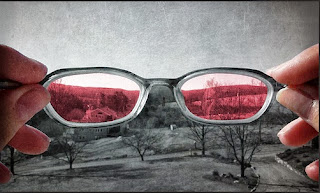
As for me? I’ll just have to keep seeing the world through—um—rose-colored glasses.  
  

Thursday, January 21, 2010

Choosing God Over the Tooth Fairy--Dedicated to Bernie Newman

My friend Bernie Newman asked me why I believe in God as opposed to say, the Tooth Fairy. I gave him a very long response and thought to blog it it since it goes to the essence of why I have become religious.

This is from the word I gave at my daughter Malka's Bas Mitzvah:

There's a Midrash that says that when the angels got wind of the fact that Hashem (God) was about to create another human being--Eve--they complained. They said to Hashem, "Why are you going to create another one of those things? They SIN!"

Hashem told the angels, "Don't worry. This new creature will be different. I will create her so that it won't be in her nature to sin."

Rabbi Samson Raphael Hirsch said that when Hashem split Eve from Adam, Eve/woman was given man's portion of innate spirituality.

Because Adam/man lost this part of himself, he would always be at risk for becoming at sea with his spirituality--would always need to actively tie himself to Hashem by dint of doing many mitzvos (commandments). Without the mitzvos, man loses his connection to his spirituality.

Take the mitzvah (commandment) of sukkah*, for instance. Men are commanded to dwell in the sukkah for an entire week. Women have no such commandment. Men need to enact the drama of living in the desert under the stars for a whole week so as to connect them to the history of their ancestors' lengthy desert-wandering. That little playing-out of ancient history is exactly what they need to get them through another year of their Jewish existence while they live out their day-to-day drudgery.


Women, on the other hand, have no need of all of those commandments because they have a direct spiritual tie to Hashem. It's inborn. Men have to strive, women are already there, close to Hashem every second of every day.

In the morning service, there is a series of blessings called the Negative Blessings. We say thank God I'm not this, and thank God I'm not that. Many feminists get P.O.'ed about the blessing that men say: Thank God I'm not a woman.

Rashi explains that men are thanking God for having more commandments--that the more commandments we have, the greater our quality of life. So, a free man has more commandments than a slave, and so forth. A man has more commandments than a woman. That's the real meaning of those blessings: we express our gratitude for what we get out of living a Torah life and fulfilling the mitzvos.

Within all those negative blessings, there is a single affirmation. Women say (channeling Popeye??): Thank God I am what I am.


I love that. Woman is saying: Thank you for creating me with innate spirituality, for making me a special kind of human being with a direct tie to You, for making me someone who isn't so inclined to sin. I am happy with my portion, even grateful!

Man, on the other hand, is lucky to have those many commandments because he needs them. It helps him alter his life from one of humdrum toil to a life that has meaning. So a man who strives to follow the mitzvos is joyful for having this constant tool for attaining the spiritual.

A woman is every bit as joyful because of her unique position of having been born spiritually whole.

As I explained to Bernie, either you buy it or you don't. There is nothing one can say about the Tooth Fairy that will speak to my soul. The reason is something inborn, because I'm a woman--a Jewish woman.


It's much harder for a man to come to and maintain faith and spirituality. It requires striving. This is what I believe with all my heart.

*Sukkah-a temporary hut that is central to the holiday of Sukkos.


Monday, November 9, 2009

Brainstorming

"If I get like that, shoot me," said Dov, talking about my latest elder care charge, "V" Okay, you're all thinking, "Hey, wait! I thought Varda was a writer."

Well, yes and no. I'm a writer, but my career fortunes rise and fall and sometimes, I swallow down my pride and take work that has nothing to do with writing, and everything to do with paying the bills. I've cleaned houses, watched babies, baked cakes, and watched the elderly. If I had my druthers, I'd never leave my keyboard, but it's an imperfect world.

The truth is there are two ages I really like: newborns, and the really old. Newborns don't care much about impressing their handlers, ditto, the elderly. There's something really attractive about that kind of honesty. Newborns are awe-inspiring for their potential, and the elderly inspire awe for the breadth and depth of their experience and knowledge.

At any rate, I have a genuine fondness for old people, and lucky for me, they seem to like me back. I now have a reputation as an A1 elder care person and I'm always being offered new positions. When my writing work is bringing in the big bucks (yeah, right), I can turn down these opportunities, but right now, I cannot.

So it was that I got a call one day from a guy looking for someone who could watch his mother who has been diagnosed with dementia. As he fleshed out the details, I had a feeling I knew the identity of the lady in question. I asked for her name, and sure enough, it was V. I told V's son, "This is a real coincidence, because I was V's neighbor for a few years and we were close friends. I'm sorry to hear about your mother, but I can't think of a better situation than to have me, her dear friend, take charge of her care."

So it was that I began the heartbreaking job of witnessing V's decline. V is a highly intelligent woman, attractive and looking much younger than her years. But V is a bit of a character, always was. So is her husband, L. Maybe that's why it took so long to diagnose V's dementia.

At any rate, somehow, I am able to understand what V is trying to express, even when she is casting about for phrases and substituting words that mean nothing like what she is trying to say. There is an unbelievable rapport between us and I have to admit that I get an inordinate amount of pleasure from being able to grant her the gift of understanding. The truth is, I don't find it much harder understanding V's speech than understanding the pre-speech of my children back in the days when they couldn't speak but ached to be understood. I was always there to provide them with that commodity.

There are other similarities between being with my new charge and spending time with infants. When my babies were small, I'd be so immersed in their worlds that I found myself mimicking their speech patterns. The same is true of spending time with V. I come home from work and find myself using word substitutions and speaking out of context. It's kind of frightening, actually. I have pointed it out to my husband and he agrees: I'm in a state of dementia for at least 10 minutes after I leave V.

Maybe this is related to the fact that I was big into drama classes as a teen and acted in any production that came my way. I still have my book on the Stanislavski Method. I can feel myself straining so hard during the five hours I care for V, trying to understand her every verbal nuance. I guess, at a certain point, I merge and become one with V. The scary part is worrying I'll get stuck and won't be able to make it back.


Sunday, November 1, 2009

Plain Food

Being a Gemini, I have a kind of ADD approach to life. I flit from thing to thing, having dozens of interests and am never quite able to decide my perfect focus. I love to act and sing. I love to write (duh). I enjoy researching my family history and I like to cook. I am enamored of the computer and of the virtual world and take pride in my prowess at manipulating Google to give me the goods. So, you'll never know what you're going to get from me here on my blog, and the truth is, I don't know, either.

So, I came here this morning, filled with ideas about what I want to write and just COULDN'T decide. I drew mental lots and chose the topic of plain food as a good start.

Yes, I'm a foodie. But I'm not a foodie who is interested in trying new and unusual recipes. I like plain food that is true to its earliest ancestor. For example, reading a recipe about lamb with apricots in phyllo dough leaves me completely cold, and maybe even a bit nauseated. I'd much rather read and follow a recipe for Craig Claiborne's Southern Fried Chicken. THAT, my friends, is mouth-watering. To me.

His recipe is mostly chicken, white flour, salt and pepper, and some Tabasco sauce. But it's out of this world. Try to gussy it up and you'll have missed the point. It's perfect. I can't bear to think or hear of people tampering with a recipe as good as that.

Southern food is a great example of the kind of food I like best: unfussy, not cluttered up with unusual ingredients in an attempt to excite the palate: it doesn't NEED anything else. Believe me, my palate is never bored with a humble piece of that Southern Fried chicken. I'm drooling all over my keyboard as I write this.

But since I'm of Ashkenazi Jewish heritage, and I have taken an interest in family research, I have melded these two interests in the form of recreating authentic recipes for Ashkenazi food. This is the kind of food that weighs you down and makes you groan. It's filled with salt and cholesterol. But hey! We only live once. I definitely don't want to have lived without enjoying my favorite foods.

I have to leave for work soon, but I wanted to give an example of a simple recipe my mother once described to me. This recipe is for Bub Tzimmes. Lithuanian Jews, such as my mother, don't generally use much sugar in their cuisine, so this recipe is kind of an anomaly. Otherwise, you can see where this recipe would have been popular for the plainness of its ingredients, for its simplicity and for its cost effectiveness. It's also a stick-to-the ribs kind of dish and probably kept a lot of Litvaks warm in those dreadful Eastern European winters. When I finally reveal the ingredients, you are going to have a bit of a shock and may be dubious that this is a dish worth trying, but I have to say it's absolutely scrumptious.

Ready? The ingredients are dried lima beans--cooked until slightly mushy, chicken fat (schmaltz), salt, pepper, and a bit of sugar. That's all. It's unctuous. It's sublime. But you will have to try it to find out. Believe me, this is authentic, plain food at its absolute best. If you're a foodie, I dare you to try it and swoon with pleasure.

My First Blog

So many friends have asked me, "When are you going to make a blog," that I finally bit the bullet. Having started a blog, I now feel that I have joined the 21st century. Here I am World, at last.

I decided to call my blog, "Judean Rose," because I live in Judea, and because my first name, Varda, means "rose" in Hebrew. Actually, it means "red rose." Sometimes the name is translated as the English flower known as a "pink," which makes sense, since the root of the word in another incarnation: Varod, means the color pink.

I was named after my paternal maternal great grandmother Rose Paul. Her Yiddish name was Raizel, which translates as, you guessed it, "rose."

In the modern world, Yiddish names are not as popular as they once were. Ashkenazi Jews have a custom of naming children after deceased relatives, and some take some leeway here. If they don't like the name as it stands, they may fiddle with it and come up with something a bit different; more to their taste. A lot of people will substitute the name "Shoshana" for the Yiddish name Raizel, but I actually have no idea why this should be so, since the meaning of the name Shoshana is "lily!"

Varda is much closer in meaning to the original Yiddish. Still, Varda has become a bit old fashioned and many would choose the more modern Vered, or perhaps, Vardit. I even had a teacher who had the name Vardina. I think her parents must have invented that name as a combination of Varda and Dina.

At any rate, a rose by any other name would smell as sweet, to paraphrase Shakespeare's famous verse, which should more properly read:
"that which we call a rose
By any other name would smell as sweet;"


At any rate, that takes care of the "rose" part of this blog. As to the Judea, well, many people call my neck of the woods, "The West Bank." But that's not a very accurate label. The term refers to the west bank of Jordan. Even the most left of left-wingers would no longer call the area in which I live, Jordan. Perhaps "disputed territories," or, "over the green line," would suit the purposes of liberals, but for me, this is just politics.

Hear me loud and clear: I am not a Zionist, but just a Jew who wants to live in the Biblical Land of Israel, A/K/A, the Holy Land, or Eretz HaKodesh, or Eretz Yisrael. Whether or not the land on which I live will ever be legally considered a part of the State of Israel doesn't change what I call this area. I call it Judea, because that's what it was called in the bible.

At any rate, I love this land with all my heart. It's my favorite part of Israel, with the exception of Jerusalem. I love the terrain, the weather, the flora and fauna. I love the clean air, and the people who live here. I could wax poetic for days about the landscape, and now that I have a blog, I may just do that at a later date. For now, it's enough to say that we have the best weather in Israel: dry with cool nights--not humid and sticky like the coastal plains. Even in midsummer, we mostly have a lovely breeze at night to refresh us from the hot daytime sun.